How to plan studying for a test
A test feels smaller when you spread your studying over a few days. Here you find out when to start, how to split the material into chunks, how many study sessions you need and what a plan for one test can look like.
Updated


When should you start studying?
The earlier you start, the smaller the chunk per day. A rule of thumb that works for many tests: start about a week ahead. For a short quiz a few days are often enough.
- 1
Check how much material there is
Count the chapters, sections or words. More material needs more days.
- 2
Look at your week
Do you have training, work or another test? Then start a bit earlier, so you do not have to do everything on a full day.
- 3
Keep the day before the test light
Plan only reviewing on that day. That leaves room if something takes longer.
How do you split the material into small chunks?
Studying for a whole test in one go feels like a lot. So split the material into chunks you can finish in one sitting, like a section or a list of words. In Dutch this is called the salami method (salamimethode): you slice the material and study a few slices each day.
- 1
Write down what the test covers
Check your study guide or ask your teacher. That way you know you are not missing anything.
- 2
Keep the chunks small
A chunk you can finish in 20 to 30 minutes is a good size to start with. If that does not work, make the chunk smaller.
- 3
Give each chunk a day
Write down what you do on each day. Then you do not have to work out where to start every time.
How many study sessions do you need?
A study session is a block in which you work on one test. How many you need depends on how much material there is and how well you already know it. An idea to start with:
- 1
A short test or quiz
Two or three study sessions, for example for a list of words or one section.
- 2
A test on one or two chapters
Four to six study sessions, spread over about a week. Pip suggests a few on the days before. If you want more, you add them yourself.
- 3
If it is more than you thought
If you notice in the first session that it is more work, add one. You can always change a plan.
How do you spread your studying and when do you review?
Study in shorter blocks over a few days and you come across the material more often, so you notice sooner what you still find hard. That leaves time to ask about it. An order that often works well:
- 1
First read and summarise
In the first sessions you read through the material and write a summary or do the exercises.
- 2
Then review
At the start of each session, look back briefly at what you did last time. Then move on to something new.
- 3
Test yourself
Close your book and see what you still know. Ask someone to quiz you, use flashcards or do the practice questions from your book.
- 4
End with a practice test
Take a practice test in your last session. Whatever you do not know yet, you review the day before the test.
What does a study plan for one test look like?
Say you have a biology test next Tuesday on chapter 4, with four sections. This is one way to spread it. On Tuesday and Friday you do nothing for biology, so there is room for other things. Adjust it to your own week.
| Day | What you do |
|---|---|
| Monday | Read sections 4.1 and 4.2 and write a short summary. |
| Wednesday | Briefly review what you did on Monday. Then read 4.3 and 4.4 and add to your summary. |
| Thursday | Do the exercises for the chapter. Mark what you still find hard. |
| Saturday or Sunday | Test yourself or take a practice test. Write down what you do not know yet. |
| Monday, the day before | Review only what you found hard. That is enough. |
| Tuesday | The test. You have seen the material a few times, spread over the week. |
How does Able to Plan help with your test?
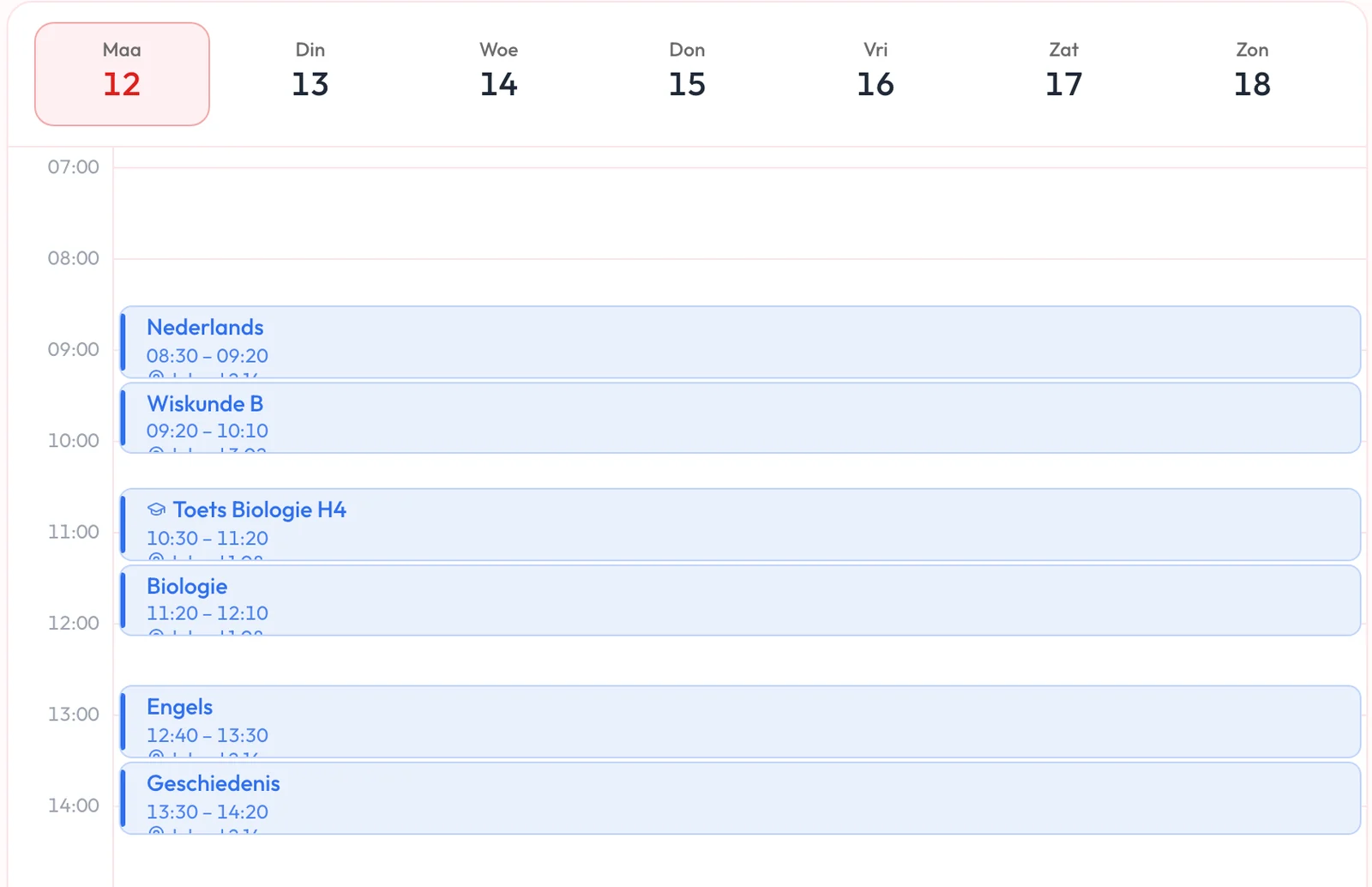
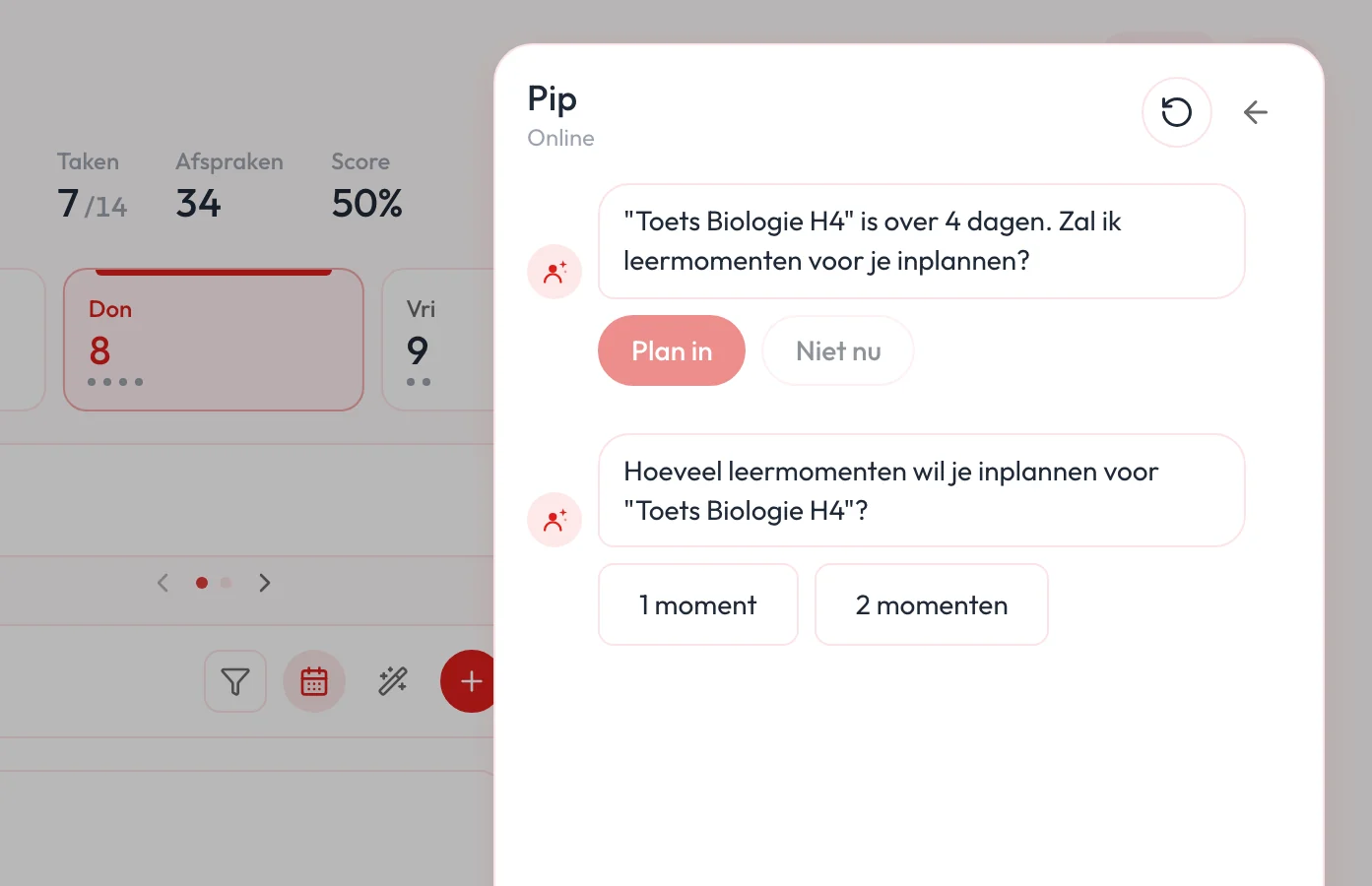
Add your test to your calendar. If the title contains a Dutch word like toets, SO or proefwerk, the app marks the appointment as a test and gives it a graduation cap. You can also mark an appointment as a test yourself. Pip then asks whether to plan study sessions for you, and you choose how many. They go into your plan as tasks, on the days before and spread according to how busy you are. Tell Pip what you need to know and you get a few concrete steps per session.
Questions about studying for a test
How far ahead should you start studying for a test?
That depends on how much material there is. A rule of thumb: start about a week ahead for a regular test, and a few days ahead for a short quiz. Then you only need to do a small chunk each day.
What is the salami method?
You split the material into small slices, like a section or a list of words, and study a few of them each day. That turns a big test into a row of small tasks you tick off one by one.
How long is a study session?
There is no fixed rule. Blocks of 20 to 30 minutes are a good start. If your focus fades, take a short break or make the block shorter.
Does Able to Plan get my tests from Magister or Somtoday?
No. Magister and Somtoday do not put tests in their calendar link. You add your test to your calendar in Able to Plan yourself, or you mark an appointment as a test.
I do not see the option to mark an appointment as a test. Why not?
You see that option, and the app only recognises tests by their title, if you picked High school student or Student in your profile. In the app it is called Exam.
Does Pip add things to my plan by itself?
Pip makes a suggestion. You choose how many study sessions you want, and only then do they go into your plan. You can still move or remove them afterwards.
Is this free?
Able to Plan has a free version for your appointments and tasks. Pip, with study sessions, is part of Premium. You can try it for free during the trial.
Plan your next test in small chunks
Add your test to your calendar and choose how many study sessions you want. You can try Pip for free during the trial.